How a 280-Square-Foot Apartment in Yokohama Quietly Dismantled Everything I Thought I Needed
The Moment the Closet Won
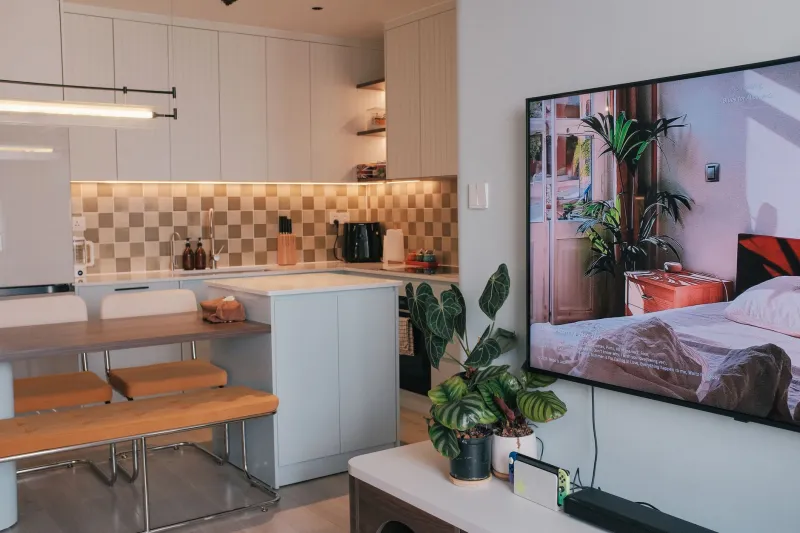
I still remember the afternoon I tried to unpack my second suitcase into my new Yokohama apartment. I stood in the middle of what the listing had cheerfully described as a "cozy 1K" — roughly 280 square feet including the bathroom — and did the mental math. There was no way. Not even close.
Something had to go. Actually, a lot of things had to go.
What followed wasn't just a decluttering exercise. It turned into one of the more quietly profound experiences of my adult life, which is a strange thing to say about getting rid of a redundant set of throw pillows. But here in Yokohama, where compact living is simply the baseline, I started to see how much of what I'd accumulated back home wasn't really mine — it was just ambient pressure made physical.
Small Spaces Are Japan's Default, Not Its Exception
It helps to understand that this isn't a hardship unique to foreigners or budget renters. Across Yokohama — and Japan broadly — living small is the norm at virtually every income level. The average floor space for a Japanese apartment hovers around 650 square feet for a full family unit, and solo dwellers frequently occupy spaces half that size.
The architecture reflects this completely. Rooms do double and triple duty. A living area becomes a bedroom at night when the futon comes out. Kitchen storage is engineered with a precision that would make an IKEA designer weep with envy. Entryways — the genkan — are deliberately compressed, almost symbolic in their smallness, as if the home is reminding you to leave the outside world behind before you step in.
For someone raised in a culture where square footage is practically a personality trait, the adjustment is jarring at first.
What Expats Actually Say After Six Months
I'm not the only Westerner who's gone through this recalibration. Marcus, a 34-year-old graphic designer from Portland who relocated to Yokohama's Nishi Ward two years ago, described his first apartment as "an intervention I didn't know I needed."
"I had a storage unit back home," he told me over coffee in Motomachi. "An entire separate room I was paying for, just to hold things I never used. When I moved here and couldn't bring most of it, I expected to feel deprived. Instead I felt — lighter? Like I'd been carrying weight I hadn't noticed."
That sentiment came up repeatedly when I talked to other expats. Diane, originally from Atlanta, put it more bluntly: "You realize pretty fast that most of your stuff existed to fill space, not to serve you. When there's no extra space, the whole equation flips."
This isn't just anecdotal. Research from UCLA's Center on Everyday Lives of Families found that American homes are among the most cluttered in the world, and that the visual chaos of accumulated possessions correlates with elevated cortisol — the stress hormone. Japanese interior philosophy, whether formally labeled minimalism or not, has long intuited what Western science is only now measuring.
The Practical Alchemy of Constraint
Living small in Yokohama forces a kind of ongoing intentionality that's difficult to maintain when you have unlimited room to sprawl. Every object you own has to justify its presence. If something doesn't earn its square footage — if it doesn't serve a function, bring genuine joy, or pull double duty — it's gone.
This sounds exhausting until it becomes automatic. And then it becomes, weirdly, freeing.
I stopped browsing online shopping apps almost entirely within my first three months, not out of discipline but out of a simple spatial logic: where would I put it? That friction — the five-second pause of but where does this actually go — turns out to be a remarkably effective filter for impulse buying. Back home, the answer to that question was always "somewhere." Here, "somewhere" doesn't exist.
The seasonal rotation system many Japanese residents use also helped rewire my thinking. Instead of owning every version of every item, you keep what's relevant now — winter bedding gets vacuum-compressed and stored when spring arrives, summer clothes cycle out in October. The wardrobe breathes. So does the mind.
Why This Resonates Right Now in America
Back in the US, there's a growing undercurrent of exhaustion with consumerism — visible in the rise of the "buy nothing" movement, the quiet popularity of capsule wardrobes, and the fact that Marie Kondo became a household name. People are increasingly aware that more stuff hasn't delivered the satisfaction it promised.
Yokohama's compact apartments aren't a trend. They're a long-standing structural reality that has quietly produced a different relationship with ownership — one where quality beats quantity, where multi-functionality is valued over specialization, and where your home is a place of genuine rest rather than a warehouse for aspirational purchases.
I'm not suggesting everyone needs to move into a 280-square-foot apartment. But after eighteen months of living this way, I've come to believe that the constraint itself was the teacher. The smallness wasn't the obstacle to a good life here. In a way I didn't expect, it turned out to be the point.
What I Actually Kept
For what it's worth, here's what survived my edit: a good knife, a French press, books I reread, clothes that fit and that I wear, a single set of quality bedding, and a low table I eat and work at depending on the hour. That's most of it.
It's enough. More than enough, actually.
And the storage unit back in Portland? I let it go six months after I arrived. The monthly fee now goes toward train tickets to places I actually want to see. That trade feels like the sanest thing I've done in years.