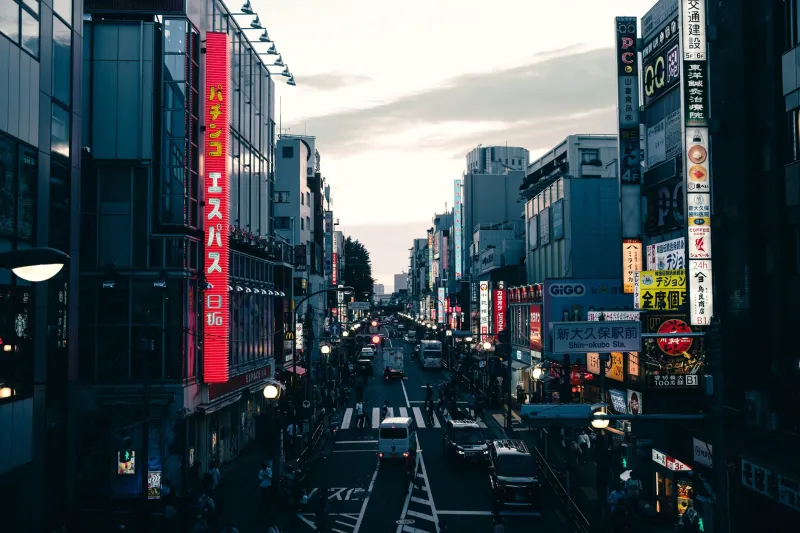
Why I Stopped Streaming American Pop and Let Yokohama's City Pop Rewire My Nervous System
I didn't come to Japan looking for new music. I came with a carry-on full of noise-canceling headphones, a Spotify queue packed with the same rotating forty songs I'd been leaning on since 2019, and the vague assumption that music was just... background. Something to fill silence while I figured out the train system.
Then one evening, sitting at a tiny counter bar in Yokohama's Noge district — the kind of place where the bartender moves like he has all the time in the world and nobody is checking their phone — I heard something come out of the speakers that made me genuinely stop mid-sip.
It wasn't dramatic. That was the whole point.
What Even Is City Pop, and Why Does It Feel Like a Memory You Never Had?
If you've spent any time in certain corners of YouTube or TikTok in the last few years, you've probably already brushed up against city pop without knowing its name. That smooth, slightly melancholic, impossibly warm sound — think Mariya Takeuchi's Plastic Love, or Tatsuro Yamashita's Ride on Time — is city pop, and it peaked in Japan somewhere between 1978 and 1991.
The genre was born out of Japan's bubble economy era, a period of almost surreal urban prosperity when Tokyo and Yokohama were glittering and fast and flush. Producers like Yamashita were pulling from American funk, West Coast soft rock, and Brazilian bossa nova, then filtering it all through a Japanese sensibility that prized smoothness over edge, atmosphere over aggression.
The result sounds like a city at night seen from a taxi window. It's aspirational without being anxious. Glamorous without demanding anything from you.
I talked to Kenji, a Yokohama-based musician in his late thirties who produces both city pop-influenced originals and teaches music production at a small studio near Kannai. He put it simply: "American pop is designed to grab you. Japanese pop — especially from that era — is designed to hold you. Very different intention."
He's right. And once you hear that distinction, you can't unhear it.
The Lo-Fi Connection: When Bedroom Producers Discovered Something Ancient
Fast forward to right now, and there's a whole global ecosystem of lo-fi hip-hop that owes a significant debt to Japanese aesthetics — and a surprising amount of it either originates in Japan or is deeply influenced by it.
The lo-fi hip-hop genre, that ubiquitous "study beats" sound that half of America apparently uses to survive finals week or get through a work-from-home afternoon, didn't come from nowhere. Its visual language — anime-style characters, rain on windows, late-night cityscapes — is explicitly Japanese. And its sonic philosophy borrows heavily from the same principles that made city pop so distinctively calming: intentional imperfection, negative space, the deliberate absence of a climax.
Mizuki, a twenty-six-year-old producer I met through a mutual friend at a record fair in Yokohama's Motomachi neighborhood, makes lo-fi tracks under a name she prefers to keep off the internet. She's soft-spoken and precise, and when I asked her why she thought Western audiences were gravitating so hard toward this sound right now, she didn't hesitate.
"Your music is very loud about feelings," she said, not unkindly. "Everything has to be the biggest emotion. The biggest drop. Even sad songs have to be big sad. I think people are tired. They want music that doesn't ask them to feel more than they already feel."
I sat with that for a while.
The American Pop Problem Nobody Wants to Name
Here's the thing about the music most of us grew up with: it's engineered for maximum emotional impact. The builds, the drops, the key changes, the belt-it-out choruses — American pop is essentially a series of escalating demands on your attention and your nervous system. Even the sad songs are cinematic. Even the chill songs have a hook that grabs.
And for a long time, that felt exciting. Now, for a lot of us, it just feels like more stimulation in a life that is already overstimulated to the point of numbness.
City pop doesn't do that. Lo-fi doesn't do that. They create a container — a sonic environment — and then they let you exist inside it without pushing you toward any particular feeling. There's no drop coming. There's no moment where the song demands you feel something. It just... continues. Warmly. Without agenda.
For someone who moved to Yokohama carrying a low-grade, constant American anxiety — the kind that hums underneath everything like a refrigerator you stopped noticing — this was, genuinely, revelatory.
Yokohama Has Its Own Frequency
Tokyo gets most of the musical credit in Japan. And fair enough — the city's sheer size means it generates more of everything. But Yokohama has its own sonic identity, and it's worth paying attention to.
As Japan's original international port city, Yokohama has always had a slightly different relationship with outside influence. Western music arrived here before it reached most of Japan. Jazz took root early. The city's port-town energy — a little rougher, a little more open, historically more comfortable with cultural mixing — gave its music scene a texture that's distinct from Tokyo's more polished output.
The bar in Noge where I first really heard city pop? The bartender told me later that the neighborhood has been a jazz and live music hub since the postwar era. There's a lineage here. A local pride in sound that isn't performative, just present.
A Starting Point: Five Tracks Worth Your Evening
If you want to start somewhere, here's a loose listening guide built from recommendations I've collected from local musicians, record store staff, and one very patient bartender:
- Mariya Takeuchi — Plastic Love — The gateway drug. Smooth, slightly wistful, impossibly good.
- Tatsuro Yamashita — Sparkle — Pure city pop euphoria without a single aggressive moment.
- Haruomi Hosono — Watering a Flower — Ambient, gentle, and genuinely strange in the best way.
- Lamp — Yume Mite Iru You (Dreaming) — A contemporary Japanese group that sounds like they were preserved in amber from 1983.
- Nujabes — Feather — The late Tokyo producer who is arguably the godfather of lo-fi hip-hop's emotional vocabulary.
That last one might be the most important. Nujabes — Jun Seba — died in 2010, but his influence on the entire lo-fi ecosystem is immeasurable. If city pop is the grandmother of this whole conversation, Nujabes is the quiet uncle who changed everything.
What the Music Is Actually Saying
I think the reason Western listeners are reaching for Japanese music right now — and reaching hard, given that city pop YouTube videos routinely rack up tens of millions of views from international audiences — is that we're collectively exhausted by the emotional maximalism of our own cultural output.
We want permission to feel less. Or rather, to feel quietly. To exist in a sonic space that doesn't demand we perform our emotions at full volume.
Japanese music, at its most characteristic, has always understood that restraint is its own kind of expressiveness. That what you leave out of a song can matter as much as what you put in. That a groove doesn't need to escalate to justify its existence.
My shoulders are still lower than they were when I got here. I'm crediting the music, at least partially.
The playlist is always open. Pull up a chair.