The Machine That Knows What You Need: Japan's Vending Culture and the Comfort We Forgot to Build
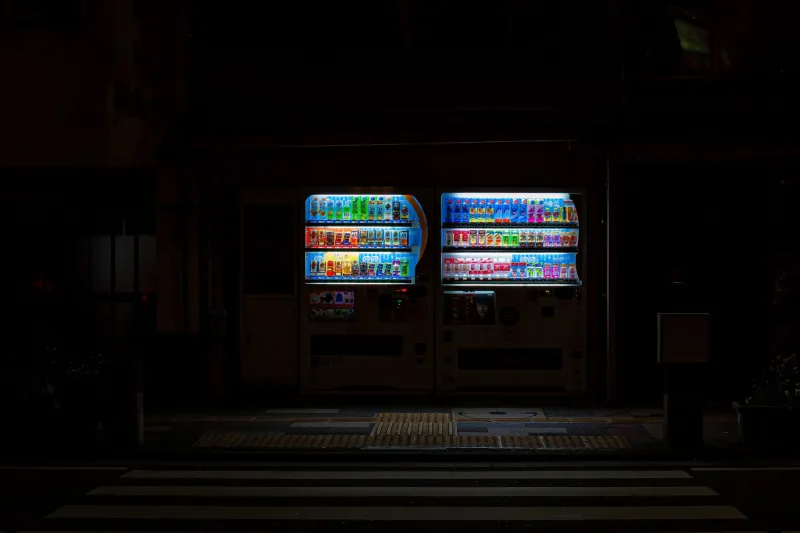
It was 12:47 AM on a Tuesday in November, and I was standing in front of a vending machine on a quiet side street in Yokohama's Nishi Ward, trying to decide between a hot can of Georgia Coffee and something labeled only with an illustration of a bear wearing a scarf.
I chose the bear.
It was warm in my hand before I even stepped away from the machine. Some kind of roasted grain tea, it turned out — nutty and slightly sweet and exactly right for a cold night when I'd been walking too long and thinking too hard. I stood there on that empty sidewalk, holding a drink chosen almost at random from a glowing grid of options, and felt something that took me a minute to identify.
I felt taken care of.
That's a weird thing to feel about a machine. But Japan has a way of doing that — of engineering small moments of comfort so seamlessly into daily life that you absorb them before you've had a chance to intellectualize them.
The Numbers, Because They're Wild
Japan has approximately 4 million vending machines nationwide. That's one for roughly every 23 people, making it the most vending-machine-dense country on the planet by a significant margin. In Yokohama alone, you genuinely cannot walk more than a few blocks in any direction without encountering one — sometimes clusters of three or four together, each slightly different in inventory, all of them lit up and humming with quiet availability.
And they sell everything. Hot drinks and cold drinks on the same machine (a feature that still delights me every single time). Canned soups. Sake. Bags of rice. Umbrellas. Fresh eggs in some rural areas. Seasonal items that rotate so frequently that checking the machine near your apartment can feel like a small adventure.
For American readers: picture a gas station convenience store, but condensed into a glowing rectangle on a sidewalk, available at 3 AM without a flickering fluorescent light or a bored cashier. That's the vibe. Except cleaner. And the coffee is somehow better.
Hot Coffee and the Architecture of Small Pleasures
The heated drink thing deserves its own moment of appreciation, because I genuinely don't think Americans understand what they're missing.
From roughly October through March, a significant portion of canned and bottled beverages in Japanese vending machines are served warm. Not lukewarm. Actually warm — the temperature of something that was just made for you. You drop in your coins (or tap your Suica card, because of course you can do that), and you receive a small aluminum can that fits in your palm like it was designed specifically for cold hands, which, honestly, it kind of was.
Georgia Coffee is the iconic one — a canned coffee brand that's been around since 1975 and has achieved the kind of cultural ubiquity that Starbucks could only dream of manufacturing. It's sweet and milky and deeply uncomplicated, and drinking one while walking to the train on a gray Yokohama morning is one of those small rituals that quietly becomes essential without you noticing.
What strikes me about all of this is how intentional it is. Someone designed these machines to respond to seasons. Someone decided that a warm drink should be physically warm to hold, not just in temperature but in the actual sensory experience of carrying it. These are small decisions, but they accumulate into something that feels like care.
What We Built Instead
Here's where I have to be honest with myself, and maybe with you.
Back in the US, our version of late-night accessible comfort is... not this. It's a drive-through line with a wait time and a 30% chance your order is wrong. It's a delivery app with surge pricing and a 45-minute window. It's a vending machine in a hospital hallway that takes only certain cards and dispenses a lukewarm Diet Coke with the enthusiasm of something that would rather not be doing this.
And I don't think that's purely a design failure. I think it reflects something about how we've structured access to comfort in America — it's either expensive and curated (the $7 artisan latte experience) or it's cheap and slightly depressing (the gas station roller hot dog). The in-between, the easy and good and just right for right now — we haven't really built that.
Japan's vending machine ecosystem exists in that middle space completely. It is not luxury. It is not scraping the bottom. It is simply: here is a warm thing that costs about $1.50, available whenever you need it, no transaction required beyond the coins in your pocket.
There's something in that gap — between what we've built and what this is — that I think points to a real difference in how the two cultures conceptualize daily comfort.
The Midnight Ritual
I've started thinking of my late-night vending machine stops as a kind of meditation, which sounds pretentious but stay with me.
There's a machine about half a block from my building that I visit maybe three or four nights a week. The selection changes just enough that I always spend a moment actually considering my options. Sometimes there's a new seasonal drink I haven't tried. Sometimes a familiar favorite is sold out and I have to recalibrate. It's a tiny decision with zero real stakes, and making it requires just enough presence that my brain has to briefly stop doing whatever anxious loop it was running.
I choose something. I pay. I receive. I walk home holding something warm.
That's the whole thing. And somehow, consistently, it works.
A therapist friend back home told me once that one of the most effective anxiety interrupts is simply completing a small, concrete task. Something with a clear beginning and end. Something where effort and result are directly proportional.
Japan's vending machines are that, scaled to an entire society.
What the Bear Tea Was Really About
I'm not trying to romanticize a coin-operated drink dispenser. I know that. But I do think there's something worth sitting with in the fact that a country of 125 million people decided, collectively, that accessible, affordable, seasonally appropriate comfort should be available on every street corner at every hour of the day.
That's a choice. Infrastructure is always a choice. And the choice Japan made says something about what they value — that ordinary people moving through ordinary days deserve small, reliable moments of pleasure. Not as a luxury. As a baseline.
I think about that when I'm back home, standing in a parking lot at 11 PM with no good options and a craving I can't easily satisfy.
The bear in the scarf would have known what I needed.