Why Japanese Couples Break Up at the Konbini (And What That Says About Love in Japan)
It was maybe 10:30 on a Tuesday night when I first noticed it. I'd ducked into the FamilyMart near Kannai station for a canned chu-hi and maybe one of those suspiciously perfect egg salad sandwiches. Standard mission. But near the back, wedged between the hot food counter and the ATM, a couple was having what I can only describe as the quietest, most devastating conversation I've ever accidentally witnessed.
No raised voices. No dramatic gestures. Just two people standing close enough to be intimate, speaking in low, careful tones, one of them staring at the floor while the other held an untouched coffee in a paper cup. They were breaking up. I was absolutely certain of it. And they'd chosen a convenience store to do it.
I thought it was a coincidence. Then I started paying attention.
The Konbini as Emotional Neutral Ground
Ask anyone who's spent real time in Yokohama — or any Japanese city, honestly — and they'll tell you the konbini is more than a place to buy snacks. It's infrastructure. It's a community anchor. It's the one space that's always open, always lit, always humming with just enough ambient noise to give two people a kind of privacy-in-public that doesn't exist anywhere else.
That ambient noise matters more than you'd think. In a quieter setting — a park, a coffee shop, someone's apartment — a difficult conversation becomes the only thing happening. Every pause is deafening. Every expression is scrutinized. But inside a konbini, the steady beep of the register, the mechanical rotation of the hot dog warmer, the cheerful automated greeting every time the door opens — all of it creates a kind of emotional buffer. A soft landing pad for hard words.
A Japanese woman I spoke with in Yokohama's Noge neighborhood — I'll call her Mika — put it plainly: "If you break up somewhere too quiet or too special, it becomes a place you can never go back to. A konbini, you still need. You still go. It doesn't become sad forever."
There's a practical genius in that logic that I genuinely hadn't considered.
Low Stakes, High Stakes
Here's the thing about American breakups, at least the ones I've had and witnessed: we tend to dramatize the location. The serious conversation at the nice restaurant. The tearful goodbye at the airport. The front porch confrontation. We match the emotional weight of the moment to the significance of the setting. Which sounds right, but also means the breakup gets permanently fused to a place. That Italian spot on Fifth Avenue? Ruined. That park by your old apartment? Skip it forever.
Japanese dating culture — at least from what I've observed living in Yokohama — seems to operate from a different premise entirely. The goal isn't to honor the relationship's weight through setting. The goal is to protect both people from unnecessary spectacle while still having the conversation that needs to happen. The konbini isn't a dismissal of the relationship's importance. It's almost the opposite: it's a considered choice to keep things contained, manageable, human.
Mika's boyfriend (now ex) had apparently suggested they "grab a coffee" on a Wednesday evening. She knew before they got there. "The konbini coffee means it will be short," she told me. "A café means maybe there is more to say. Konbini means it is already decided."
I sat with that for a long time.
Is It Avoidance, or Is It Intelligence?
Western observers — myself included, at first — might be tempted to read the low-key konbini breakup as emotional avoidance. Like, if you really cared, wouldn't you do it somewhere that reflects how much the relationship meant? Wouldn't you owe the other person a proper setting?
But I've started to think that framing is pretty culturally loaded. The American instinct to perform emotional significance — to show how much something mattered through grand gestures, even painful ones — isn't necessarily more emotionally intelligent. It's just more theatrical.
What I've watched play out in Yokohama's konbinis is something quieter but not necessarily shallower. There's a care in choosing a space where neither person will completely fall apart. Where the exit is always right there. Where a vending machine coffee gives your hands something to do when you don't know what to do with them. Where no one is trapped across a tablecloth from each other for the duration of a four-course meal.
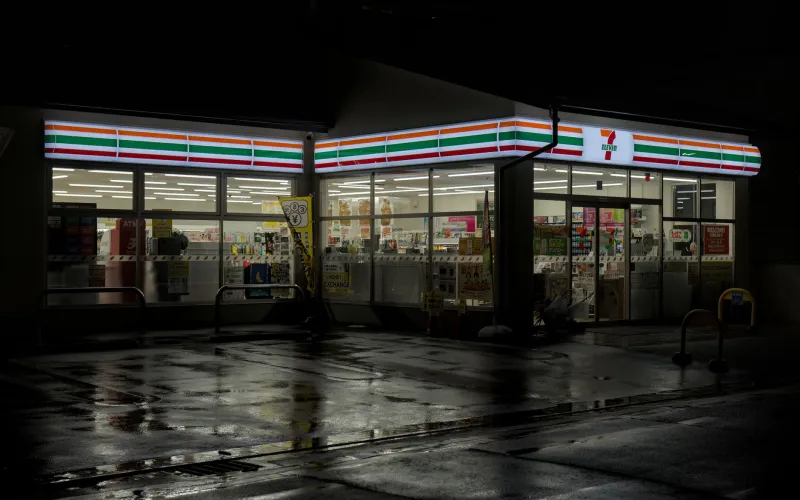
A guy I met at a bar in Motomachi — expat, had been in Japan for three years — told me his Japanese girlfriend had ended things with him at a 7-Eleven and he'd initially been furious about it. "I thought she was being dismissive. Like, couldn't we at least go somewhere real?" But months later, he said he'd come around. "She was protecting both of us. I just didn't have the framework for it yet."
The Coffee You Don't Finish
There's a specific detail that keeps coming up when people describe these konbini endings: the unfinished coffee. You buy it — or someone buys it for you — and it just kind of... sits there. It's a prop, a gesture, something to do with your hands. And when the conversation is over, when the thing has been said, you leave the coffee on the counter or in the little trash bin by the door, and you walk out.
Something about that image has stuck with me. The coffee you bought but didn't drink. The transaction that was never really about the coffee.
There's a whole language of objects in Japanese emotional culture — the gift that says what the words won't, the meal that communicates care more than any declaration would. The konbini coffee fits somewhere in that same vocabulary. It's not nothing. It's just not what it looks like.
What It Actually Reveals
Living in Yokohama has handed me so many moments like this — situations where my first read was completely wrong, where the Western emotional script I'd been running didn't apply. The konbini breakup is one of the more elegant examples.
It's not cold. It's not lazy. It's a culturally specific solution to a universal human problem: how do you end something painful without making it more painful than it has to be? How do you give someone the truth without turning the truth into a performance?
Maybe the answer isn't always a dramatic setting and a long conversation. Maybe sometimes it's a paper cup of coffee, a familiar fluorescent light, and the quiet dignity of an ending that doesn't need an audience.
I'm still thinking about that couple near the ATM in Kannai. I hope they're both okay. I hope they still go to that FamilyMart.