Japan Has 5 Million Vending Machines and Zero Apologies About It
I grew up thinking vending machines were for desperate situations. You're stuck at a highway rest stop at midnight. The office break room is out of coffee. The gym lobby has one sad machine that takes your dollar and gives you nothing. That was my entire relationship with vending machines for the first twenty-something years of my life.
Then I moved to Yokohama.
Within my first week, I bought a hot can of coffee at 7 AM from a machine outside a train station, a cold sports drink at noon from one tucked into a parking garage stairwell, and — I'm not making this up — a warm cup of corn soup from a machine outside a convenience store at 11 PM. Same format, same basic interface, completely different product and temperature and moment in my day. By the end of that week, I stopped thinking of vending machines as a last resort and started thinking of them as infrastructure.
Because that's exactly what they are here.
The Numbers Don't Lie, But They Do Astonish
Japan has somewhere in the neighborhood of five million vending machines. That's roughly one for every 23 people. Put another way: if you're standing anywhere in an urban area in Japan, you are almost certainly within 100 meters of a vending machine. Probably less.
America, by comparison, has around seven million — but spread across a country more than 26 times Japan's land area, servicing a population nearly three times as large. The density isn't even close. And density, it turns out, is the whole point.
In Yokohama specifically, you start to notice the machines the way you notice fire hydrants back home — they're just part of the street furniture, so integrated into the urban fabric that you stop registering them consciously. Until you need one. And then it's always right there.
Hot and Cold Is Just the Beginning
The thing that catches most American visitors off guard isn't the number of machines — it's the sophistication of what's inside them.
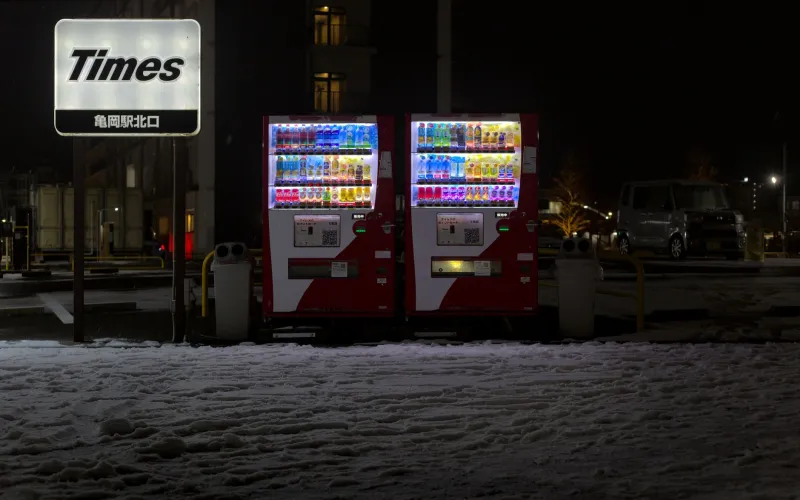
The hot/cold dual system alone would blow minds back home. Japanese beverage machines don't just stock room-temperature drinks. They maintain two separate temperature zones simultaneously: cold items on one side, hot items on the other. The labels are color-coded — blue tabs for cold, red tabs for hot. You can buy a scalding can of milk tea and an ice-cold green tea from the same machine in the same transaction. The technology isn't new; Japan has been doing this since the 1970s. But it still feels almost unreasonably thoughtful compared to what we're used to.
Beyond beverages, the ecosystem expands in ways that feel almost satirical until you realize how genuinely useful they are. Machines stocked with umbrellas outside train stations when rain is forecast. Machines selling fresh eggs near rural farms. Ramen vending machines — not the cup kind, actual frozen ramen kits — positioned outside restaurants that are closed for the night. Machines with ties and dress shirts near business districts, for the salaryman who spilled something on the way to a meeting. Machines selling live bait near fishing spots.
Each one of these exists because someone identified a real, recurring need in a specific location and designed a solution around it. That's not vending machine logic. That's retail logic applied with unusual precision.
The Trust Factor Nobody Talks About
Here's something that took me a while to articulate but feels important once you see it: Japan's vending machine economy runs on an almost radical level of social trust.
These machines aren't locked inside buildings or monitored by security cameras (well, not obviously). They sit on sidewalks, in alleyways, outside temples, at the edge of rice fields in the middle of nowhere. They get restocked regularly. They almost never get vandalized or broken into. The theft rate is negligibly low.
In the US, an unattended vending machine in a low-foot-traffic area is basically an invitation. We've all seen the aftermath — cracked screens, jammed slots, machines rocking on their bases from someone trying to shake out a stuck bag of chips. The machines we design reflect the society we've built: one where unattended property in public space is assumed to be vulnerable.
Japanese vending machines reflect a different assumption entirely. The social contract here includes the implicit understanding that you pay for what you take, that you don't damage shared infrastructure, and that public space is maintained collectively. The machines aren't naive — they're calibrated to the culture they operate in.
That's not something you can import. You can buy the machine. You can't buy the social conditions that make it work.
Payment in 2024 (and 1994)
Japanese vending machines have always been early adopters of payment technology — and also somehow frozen in time. It's a paradox that makes perfect sense once you understand Japanese consumer culture.
On the cutting edge: most machines now accept IC cards like Suica and Pasmo (the same cards you tap to ride the train), QR code payments, and various mobile wallet systems. Cashless transactions at vending machines have surged post-pandemic. Some machines have touchscreens, loyalty point integration, and real-time inventory displays.
And also: a huge percentage of Japanese vending machine transactions still happen in cash. Coins, specifically. Japan remains a cash-heavy society in ways that surprise most Western visitors, and vending machines are part of that ecosystem. The machines are engineered to handle coins with almost obsessive precision — they sort, count, and return change with a speed and accuracy that makes American machines feel broken by comparison.
The coexistence of cutting-edge and deeply traditional payment methods isn't a contradiction. It's Japan being Japan: honoring what works while quietly absorbing what's new.
What This Actually Says About Japanese Consumer Culture
Spend enough time with Japan's vending machine ecosystem and a broader picture starts to emerge. These machines aren't just about transactions. They're about a specific set of values that run through Japanese consumer culture at every level.
Efficiency — the machine is always available, never has a line longer than one person, never closes for a holiday.
Consistency — the product you bought yesterday is the product you'll buy today. Same temperature, same taste, same price.
Accessibility — not in the American ADA-compliance sense, but in the sense that the thing you need is always nearby, always working, always ready.
And underneath all of it: a baseline respect for the customer's time that doesn't require a human interaction to execute. There's no upselling. No loyalty card pitch. No "did you find everything okay today?" The machine gives you what you came for and gets out of your way.
American retail has spent decades trying to manufacture that kind of frictionless experience through apps and self-checkout and contactless payment. Japan built it into the street furniture fifty years ago.
I think about that every time I tap my Suica card at a machine outside Sakuragicho Station and walk away with a hot coffee in under ten seconds. Which, at this point, is basically every morning.
Some infrastructure just fits the life it was built for.